
Accurate hull models from whatever drawings you have
When a vessel is in trouble, the full design package is rarely available. A general arrangement, a capacity plan, principal dimensions and a deadweight scale is often all there is.
Our naval architects build accurate, hydrostatically validated 3D hull models for vessels that have no full lines drawing, producing a preliminary hull model in minutes. Iterative solving then drives the model to match known displacement and drafts.
Hull models from limited information
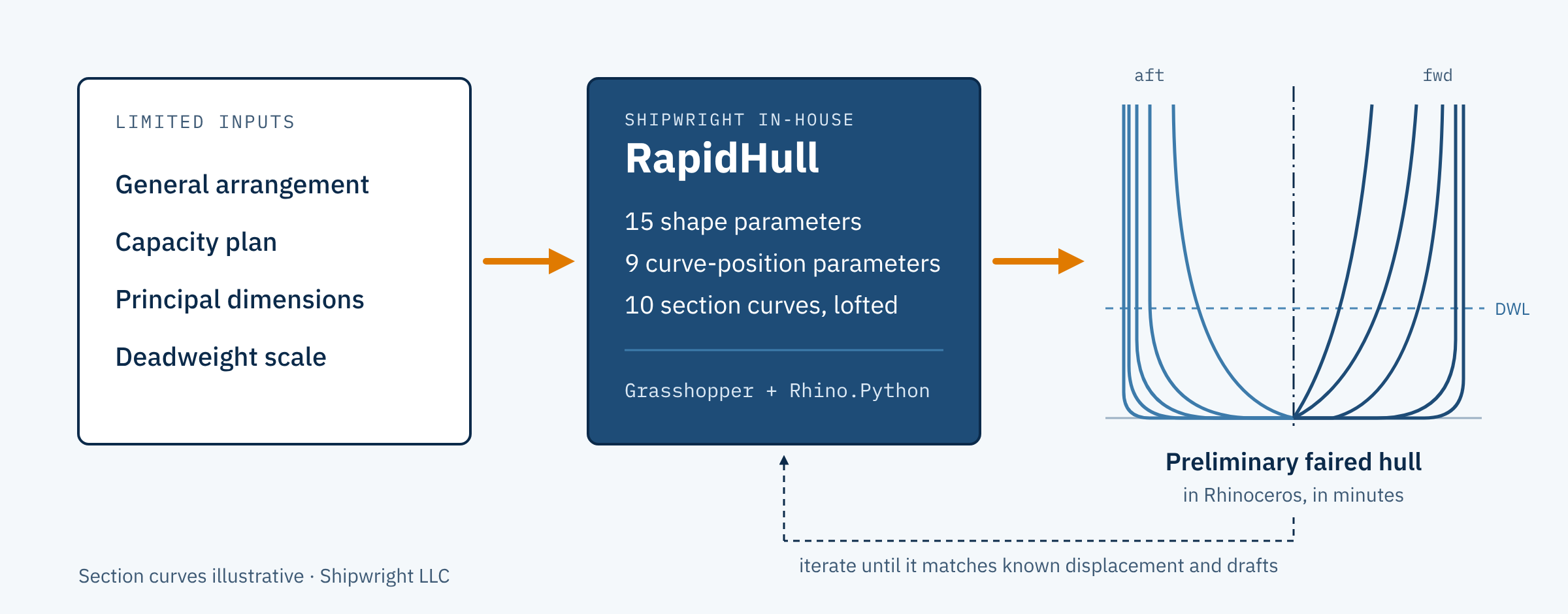
RapidHull turns a handful of numbers into a faired hull in Rhino, then iterates until the model matches the ship.
Parametric hull generation
Inputs we’ve worked from:
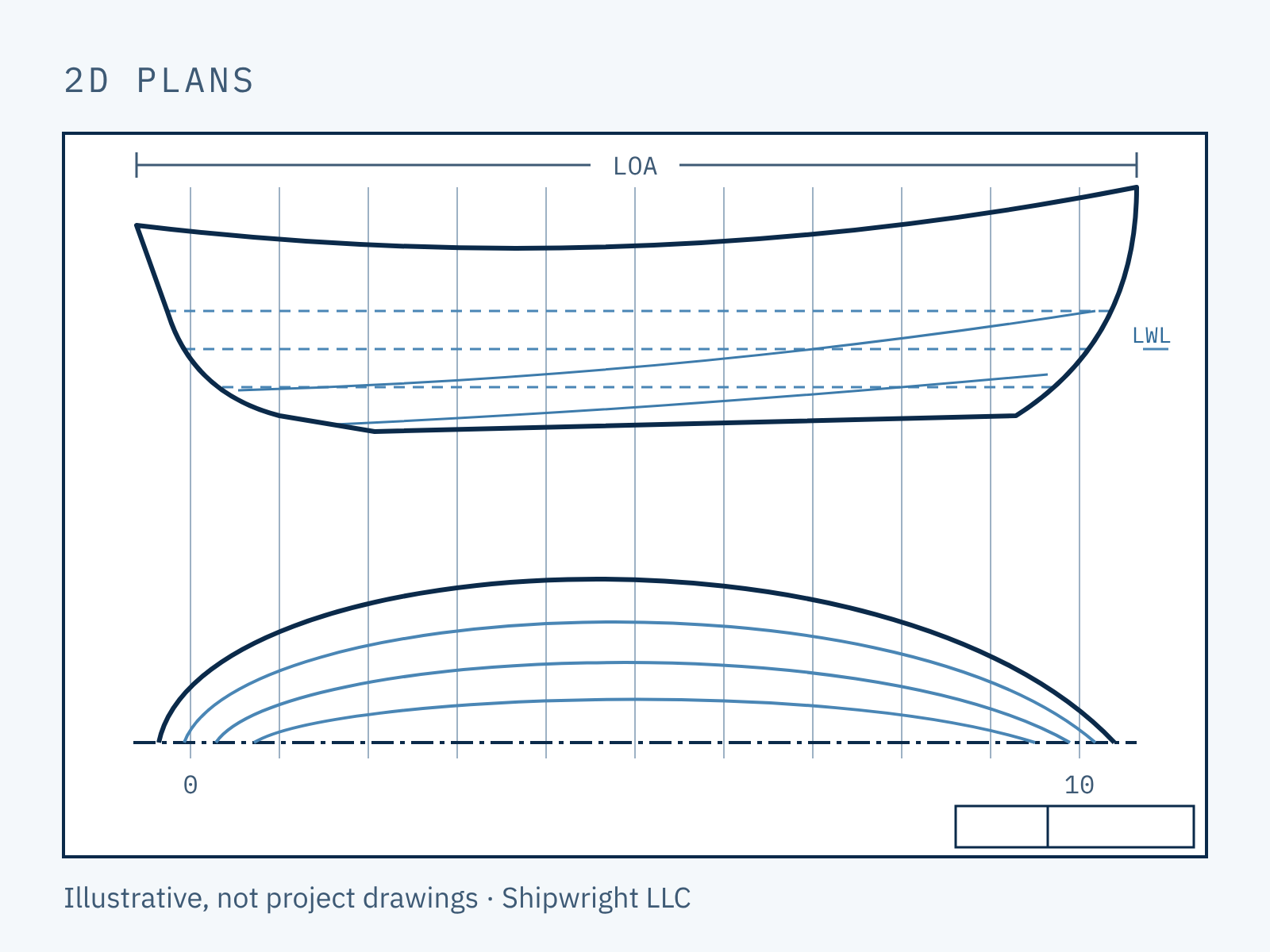
2D plans, principal dimensions and a deadweight basis: a 276 ft historic sailing vessel in support of a major salvage operation
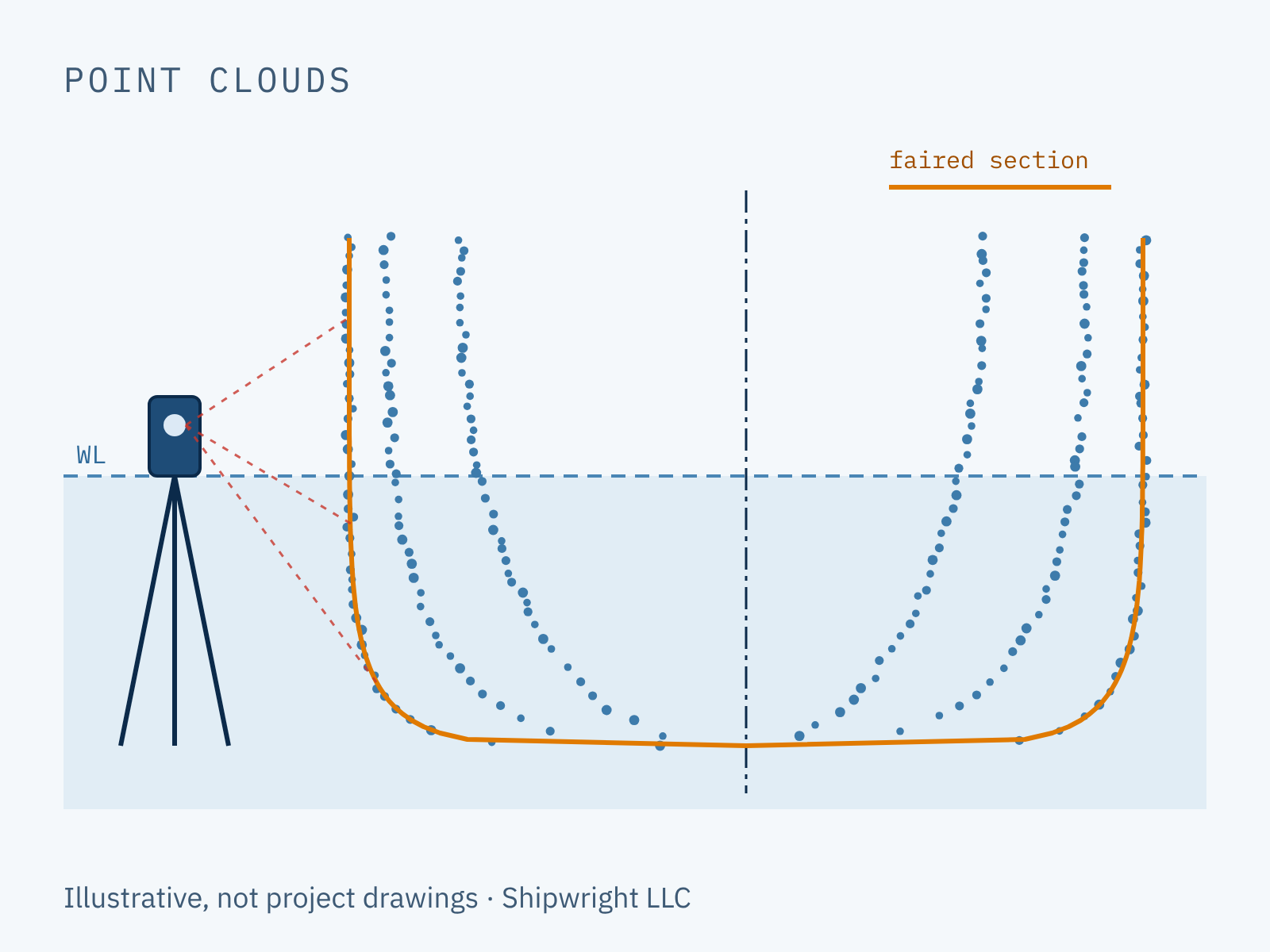
Laser-scan point clouds captured by our own team: a below-waterline model of a 70,367 GT cruise vessel
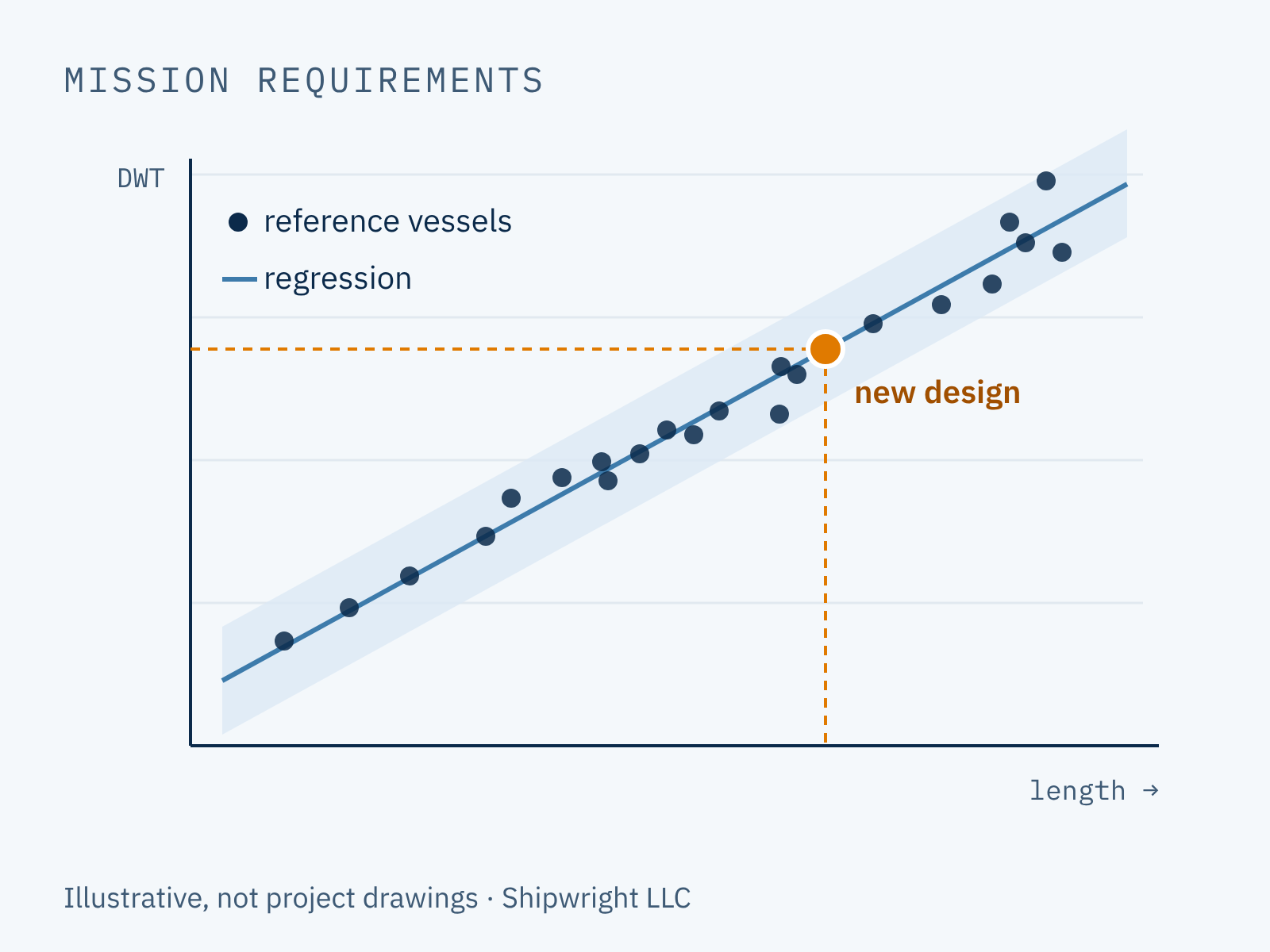
Mission requirements and regression techniques: a 3,934 TEU containership
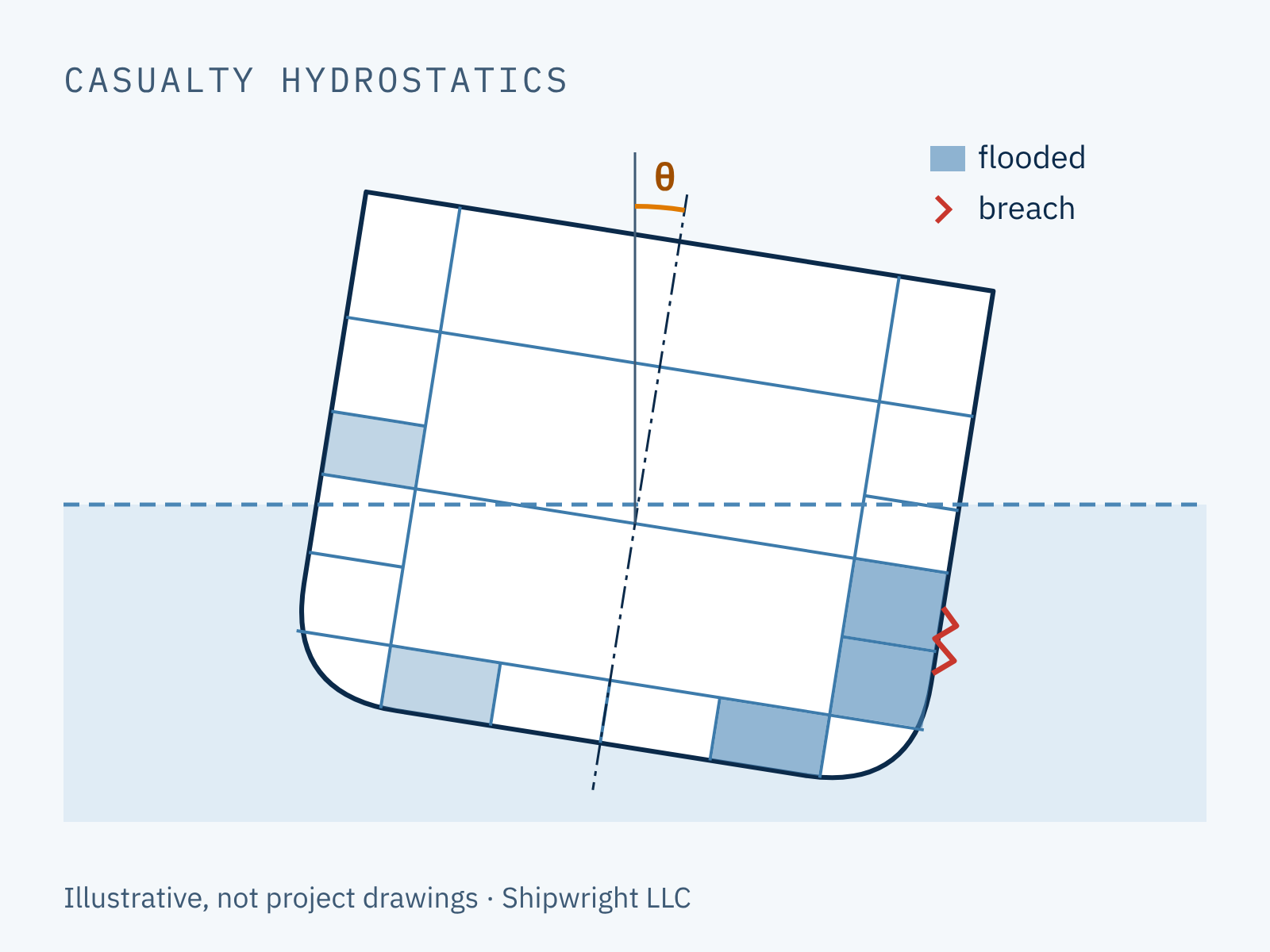
Live casualty hydrostatics: weekly analysis through the multi-year remediation of a historic 872 ft aircraft carrier
Every hull we deliver is checked against known vessel data and independently reviewed by a licensed Professional Engineer before release.
Our in-house engineers generate a faired hull in Rhino from shape parameters and curve-position parameters, lofted through section curves. A preliminary hull model takes minutes, with little manual work.
Built-in Grasshopper and the stock Rhino Python editor. No third-party plug-ins, so models open cleanly on any standard Rhino seat.
Iterative solving drives the model to match known displacement, drafts and deadweight.
Output validated against the vessel’s hydrostatic data to the accuracy of IMO MSC.1/Circ.1229, Guidelines for the Approval of Stability Instruments.
From any input to a working model
2D drawings and capacity plans
A Rhino hull model of a historic sailing vessel, built from limited 2D plans, principal dimensions and a deadweight basis, in support of salvage engineering.
Point clouds
A detailed below-waterline model of a cruise vessel, reconstructed directly from laser-scan point clouds captured by our own team. See 3D scanning.
Parameters and regression
A Rhino and GHS model of a containership, developed from mission requirements and industry-standard regression techniques, with full hydrostatic and structural analysis across loading conditions.
Live casualty hydrostatics
Weekly hydrostatic analysis and deadweight surveys through the multi-year remediation of an aircraft carrier, keeping a live stability picture across hundreds of tanks.
Hydrostatics, validated
Every hull we deliver carries its numbers with it: displacement and deadweight, drafts and trim, LCB, VCB and LCF, KMt, KMl and GM, righting-arm (GZ) curves, and tank capacities and soundings, for intact and damaged conditions.
Each model is checked against known vessel data and independently reviewed by a licensed Professional Engineer before release.
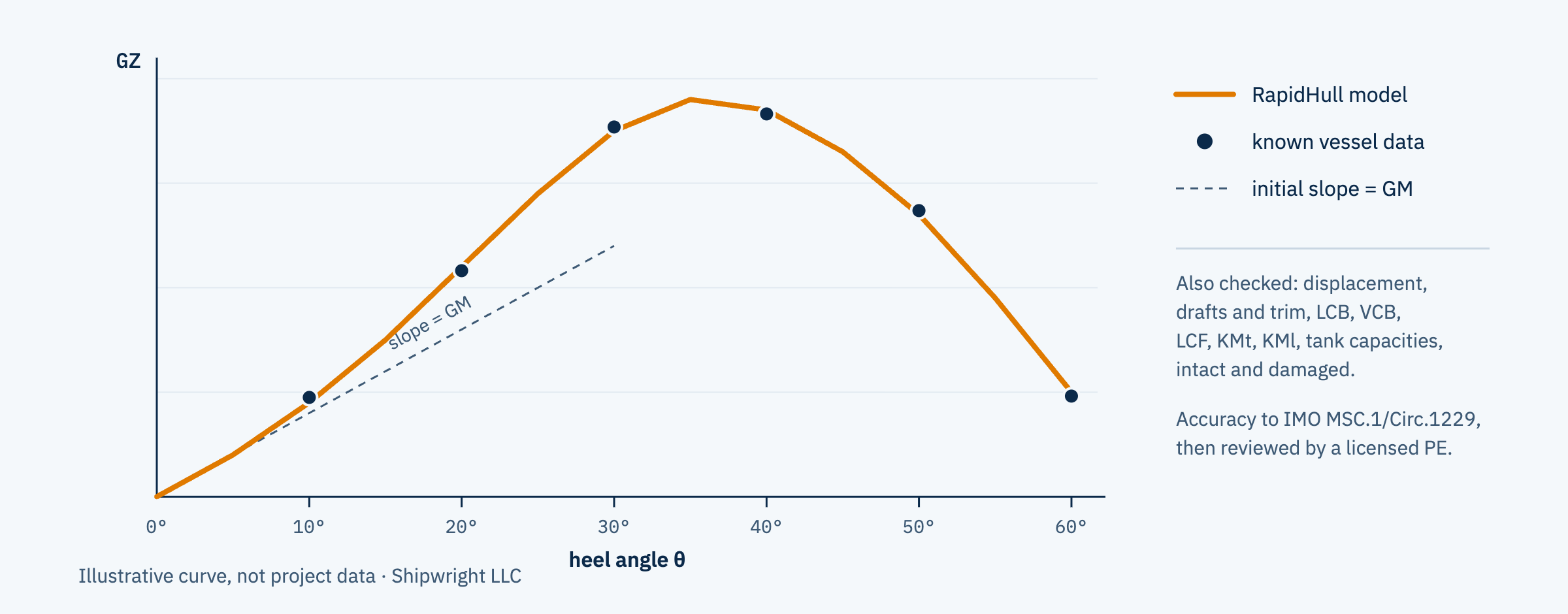
An illustrative righting-arm curve: a model is accepted when it passes through the vessel’s known data.
Scripts your team can run
We write documented, maintainable Python inside the stock Rhino distribution and deliver it with inline comments and a written methodology so your engineers can run, audit, and extend it. Recent examples:
Parametric planing hull with hard chine: a complete hull from 11 inputs, including principal dimensions, angular and fullness parameters, and chine width.
Parametric Wigley hull with variable bow rake: the widely used research hull from four inputs, with a scripted station transform for custom bow geometry.
Toolchain: Rhino, Grasshopper and Rhino.Python; General HydroStatics (GHS); HECSALV; in-house regression and parent-ship libraries.
Need a hull model and there’s no lines drawing?
Send us what you have, even if it’s a single general arrangement. We’ll tell you what we can build from it.
Custom maritime software
Beyond hull modeling, we build custom applications for the maritime industry: fleet and inspection tools, engineering calculators, and workflow software that is straightforward to support and works with the software your teams already run.